Published October 27, 2026 · Last reviewed October 27, 2026 · Robert H. Thornburg
Why the First 48 Hours Matter
What a business does in the first two days after a trademark cease and desist letter arrives often shapes the entire dispute: its cost, its leverage, and its worst-case exposure. A letter is not a lawsuit, but it is frequently the moment a court will later treat as the point when litigation became reasonably foreseeable.
That date matters for three reasons: (1) it can trigger a legal duty to preserve documents and electronically stored information (ESI), (2) it marks the point after which continued use may be portrayed as knowing or willful, (3) and every email, Slack message, or social post written after it may become an exhibit in a trial.
This post walks through the claims most often asserted in Florida trademark demand letters, the immediate steps an accused business should take, why a company-wide ESI preservation notice belongs at the top of the list, how to think about exposure to disgorgement of profits, why an honest internal review of prior knowledge is essential, and ten concrete recommendations to complete before contacting outside trademark counsel and before sending any written response.
The goal is not to replace counsel. It is to make sure that when you do sit down with counsel, the record is intact, the facts are organized, and nothing has been said or done that cannot be undone.
The Claims You Are Likely Facing
Most Florida trademark demand letters stack federal and state theories together, because each carries different elements and different remedies. Knowing which claims are asserted tells you what facts matter and what money is at stake.
| Claim | Source of law | What the accuser must generally show |
|---|---|---|
| Federal infringement of a registered mark | Lanham Act § 32, 15 U.S.C. § 1114 | A valid federal registration and use in commerce of a mark likely to cause confusion |
| False designation of origin / unregistered mark infringement | Lanham Act § 43(a)(1)(A), 15 U.S.C. § 1125(a) | Enforceable rights (registered or common law) and a likelihood of confusion as to source, sponsorship, or affiliation |
| False advertising | Lanham Act § 43(a)(1)(B) | A false or misleading statement of fact in commercial advertising that is material and causes or is likely to cause injury |
| Federal dilution | Lanham Act § 43(c) | A mark that is famous to the general consuming public in the U.S., and use likely to cause blurring or tarnishment, regardless of confusion |
| Florida registered mark infringement | Fla. Stat. § 495.131 | A mark registered with the Florida Department of State and likely confusion |
| Florida dilution | Fla. Stat. § 495.151 | A mark famous in Florida and use likely to dilute it |
| Florida common law unfair competition and infringement | Florida common law (rights preserved by Fla. Stat. § 495.161) | Prior common law rights and likelihood of confusion; analyzed much like Lanham Act claims |
| Deceptive and unfair trade practices | FDUTPA, Fla. Stat. § 501.201 et seq. | A deceptive act or unfair practice in trade, causation, and actual damages |
In the Eleventh Circuit, likelihood of confusion is weighed through seven factors: the strength of the plaintiff’s mark, the similarity of the marks, the similarity of the goods or services, the similarity of trade channels and customers, the similarity of advertising media, the defendant’s intent, and evidence of actual confusion. Notice that intent is one of them. That is why the prior knowledge review discussed below matters so much.
Two practical points. First, a business that operates only in Florida is not insulated from the Lanham Act; online sales, out-of-state customers, and internet advertising usually satisfy the commerce requirement. Second, the absence of an ® symbol or a federal registration does not mean the accuser has no rights. Common law rights arise from use alone, though they are generally limited to the area where the mark is actually known.
The First 48 Hours at a Glance
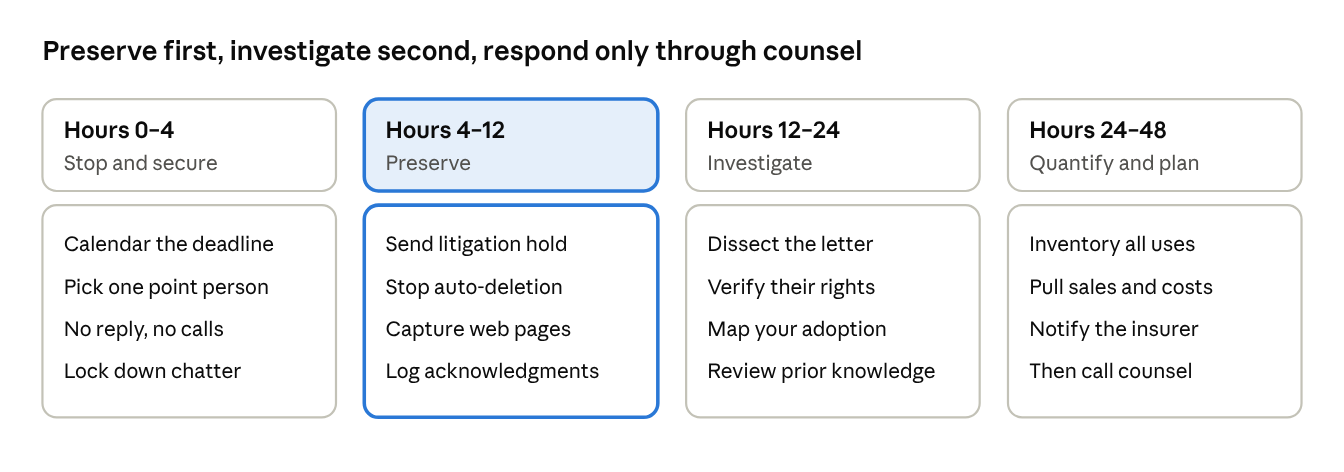
The order matters: preservation comes before investigation, and both come before any written response. Each step is explained in detail below.
Issue a Company-Wide ESI Preservation Notice Immediately
The single most important step in the first 48 hours is a written, company-wide litigation hold. Many trademark defenses are won or lost on documents, and a lost record can hurt more than a bad one.
Why the duty may already exist
The duty to preserve evidence arises when litigation is pending or reasonably anticipated. A cease-and-desist letter that threatens suit, identifies specific marks, and demands action is often treated by courts as the trigger. From that point, routine deletion that was harmless the week before can become spoliation.
In federal court, Federal Rule of Civil Procedure 37(e) governs lost ESI. If a party failed to take reasonable steps to preserve it and the information cannot be restored or replaced, the court may order measures to cure the prejudice. If the court finds an intent to deprive the other side of the information, it may instruct the jury to presume the information was unfavorable, or even dismiss the defense or enter a default judgment. Florida state courts apply their own rules, including Florida Rule of Civil Procedure 1.380(e), and Florida courts have long imposed adverse inferences and other sanctions where relevant evidence is lost.
The practical lesson: a business cannot rely on a “we never meant to delete it” argument. Reasonable, documented steps taken promptly are the best protection.
Who Should Receive the Notice
- Owners, officers, and managers who chose, approved, or used the accused name, logo, or tagline
- Marketing, branding, advertising, and social media staff, including outside agencies and freelancers
- Product development, design, and packaging personnel
- Sales, e-commerce, and customer service teams (they hold evidence of actual confusion, or its absence)
- Finance and accounting (sales, cost, and profit data drive any monetary claim)
- IT and anyone who administers email, cloud storage, collaboration tools, or the website
- Affiliated companies, licensees, distributors, and key vendors who used or produced the accused materials
What it Must Cover
The notice should describe categories broadly, by subject rather than by file name. At a minimum:
- All documents and communications concerning the selection, clearance, adoption, design, and first use of the accused name, mark, logo, slogan, or trade dress
- Any trademark searches, search reports, watch notices, or USPTO and Florida Department of State records reviewed
- All communications that mention the accuser, its marks, its products, or the letter itself
- Every version of the website, product listings, marketplace pages (for example, Amazon or Etsy), app store pages, and social media accounts using the accused designation
- Advertising and marketing materials, including paid search keyword lists, ad copy, metatags, hashtags, and influencer content
- Product labels, packaging, signage, catalogs, trade show materials, and samples
- Sales, revenue, cost, margin, and profit records for accused goods or services, by product, channel, and period
- Customer and vendor communications, including any misdirected inquiries, complaints, returns, or reviews suggesting confusion
- Domain name registration and renewal records
- Contracts with designers, agencies, manufacturers, licensees, distributors, and insurers that touch the accused branding
Where ESI lives
Think beyond a generic “email”. Relevant data commonly sits in company and personal email, text messages and iMessage, WhatsApp and Signal, Slack or Microsoft Teams, Google Drive, Dropbox, SharePoint, OneDrive, design platforms such as Canva, Figma, or Adobe Creative Cloud, e-commerce back ends such as Shopify, marketplace seller portals, accounting systems such as QuickBooks, CRM systems, website content management systems and hosting backups, social media accounts including drafts and direct messages, and phones or laptops owned by employees but used for work.
Suspend automatic deletion
The notice is not enough on its own. IT should suspend auto-delete and retention policies that would purge relevant data, disable disappearing-message settings on work chats, stop the scheduled wiping or recycling of departing employees’ devices and accounts, and preserve backups. Before anyone edits or takes down a webpage or listing, capture it first with dated screenshots or a web archive and keep a copy of the underlying files.
Document the hold
Keep a record of who received the notice, when, and their acknowledgments. Send reminders periodically and to new custodians as they are identified. Release the hold only on advice of counsel.
Sample core language
Legal Hold: Preservation of Documents and Electronic Information. The Company has received a letter asserting trademark and related claims concerning our use of [ACCUSED NAME/LOGO]. Effective immediately, you must preserve, and must not delete, alter, discard, or overwrite, any documents or electronic information, in any format and on any device or account (including personal devices and messaging apps used for work), relating to [ACCUSED NAME/LOGO], [ACCUSER NAME] or its marks, or the products and services offered under [ACCUSED NAME/LOGO]. This obligation overrides any routine deletion practice or retention schedule. Do not discuss this matter with anyone outside the Company, and do not create new documents commenting on the merits of the claims. Direct all questions to [POINT PERSON]. Please confirm receipt by replying to this notice.
That last instruction matters. The hold should preserve existing information without inviting employees to write fresh, unprivileged opinions about whether the company infringed.
Understand Your Exposure to Disgorgement of Profits
The largest monetary risk in many trademark cases is not the accuser’s lost sales, but rather disgorgement of the accused infringer’s own profits. Businesses that understand this early make better decisions about whether to keep selling, how to respond, and when to settle.
How disgorgement works under the Lanham Act
Under 15 U.S.C. § 1117(a), a prevailing plaintiff on infringement, false designation, false advertising, or willful dilution claims may recover, subject to principles of equity, the defendant’s profits, the plaintiff’s damages, and costs. The burden-shifting rule is what makes profits so dangerous: the plaintiff need only prove the defendant’s sales, and the defendant must prove every cost or deduction it claims. A business that cannot document its costs may find gross revenue treated as profit.
The court may increase a damages award up to three times actual damages, and may adjust a profits award it finds inadequate or excessive to a sum it considers just. In exceptional cases, the court may also award reasonable attorney’s fees.
Willfulness is not required, but it still matters
In Romag Fasteners, Inc. v. Fossil Grp., Inc., 590 U.S. 212 (2020), the U.S. Supreme Court held that willfulness is not a strict precondition to a profits award for trademark infringement, while recognizing that the defendant’s mental state remains a highly important consideration. In practice, evidence that the accused infringer knew of the mark and pressed ahead makes a profits award more likely and larger, and supports an exceptional case fee award. Continued sales after receiving a demand letter are often cited as evidence of willfulness.
Dewberry: whose profits count
In February 2025, the Supreme Court decided Dewberry Grp., Inc. v. Dewberry Eng’rs Inc., 604 U.S. 321 (2025). The Court unanimously held that disgorgement of the “defendant’s profits” may reach only the profits of named defendants, not those of affiliated companies that were never sued. The ruling vacated a roughly $43 million award built on the combined profits of Dewberry Group and its separately incorporated, property-owning affiliates.
This ruling has two takeaways for an accused business. First, corporate structure matters: which entity actually sells the accused goods and books the revenue will shape the exposure. Second, accusers are now on notice to name affiliates directly. The Court also left open whether a district court might still account for affiliates’ profits under the statute’s “just sum” language, or through veil piercing. Expect that question to be litigated.
Florida statutory remedies
Florida’s trademark statute carries similar risk for marks registered with the State. Under Fla. Stat. § 495.141, a court may order defendants to pay the profits derived from, and the damages caused by, the wrongful use. As under federal law, the plaintiff proves only the defendant’s sales, and the defendant must prove every claimed cost or deduction. The court may enter judgment for up to three times actual damages and may award reasonable attorney’s fees to the prevailing party. Because that fee provision runs to the prevailing party, it cuts both ways. Florida dilution under § 495.151 can open the same monetary remedies where the use was willful, and FDUTPA claims add actual damages and their own prevailing party fee exposure.
Other monetary exposure to flag early
| Remedy | Source | When it applies |
|---|---|---|
| Mandatory trebling and fees | 15 U.S.C. § 1117(b) | Intentional use of a counterfeit mark, absent extenuating circumstances |
| Statutory damages | 15 U.S.C. § 1117(c) | Counterfeiting cases, as an alternative to actual damages; higher ceilings for willful conduct |
| Monetary relief for dilution | 15 U.S.C. § 1125(c)(5) | Generally only where the dilutive use was willful |
| Limits for lack of registration notice | 15 U.S.C. § 1111 | Profits and damages for a registered mark may be barred if the owner did not use the ® notice and the defendant lacked actual notice of the registration |
| Personal liability | Lanham Act case law | Officers and owners who actively direct or participate in infringing conduct can be named individually |
What to gather now
Before speaking with counsel, finance should quietly pull revenue for accused goods and services by product, channel, and month since first use, together with the cost records that would support deductions: cost of goods, freight, marketplace fees, advertising spend attributable to the products, and allocable overhead. Also identify which legal entity made each sale. This is not about conceding liability. It is about knowing your worst case before anyone else frames it for you, and that § 1111 notice point is worth checking against the accuser’s own packaging and website.
Evaluate Internally Any Prior Knowledge of the Mark or Registration
The accuser will want to know when you first learned of its mark, and you need to know the answer before they do. Prior knowledge can turn a good-faith naming coincidence into an alleged willful infringement, and it bears on liability and remedies at once.
Why knowledge matters
- Likelihood of confusion. The defendant’s intent is one of the Eleventh Circuit’s seven confusion factors. Evidence that a business adopted its mark to trade on another’s goodwill can weigh heavily.
- Profits and enhanced remedies. After Romag, willfulness is not required for disgorgement, but it remains among the most important equitable considerations. It also supports enhanced damages and an exceptional case fee award.
- Dilution. Monetary relief for federal dilution generally requires willfulness, and Florida dilution remedies beyond an injunction turn on willful intent.
- Constructive notice. A federal registration on the Principal Register is constructive notice of the registrant’s claim of ownership under 15 U.S.C. § 1072. Not knowing about a registered mark does not defeat infringement, though it remains relevant to intent and remedies.
- Defenses. Knowledge also cuts the other way. A business that adopted and continuously used its mark in good faith before the accuser’s registration or priority date may have a prior user or limited area defense, such as under 15 U.S.C. § 1115(b)(5). Establishing good faith requires an honest look at what was known and when.
Questions to answer
- Who proposed the accused name, logo, or slogan, and what inspired it?
- Was a trademark clearance search done? By whom, when, and did it list the accuser’s mark?
- Did anyone in the company know of the accuser, its products, or its mark before adoption? After adoption but before the letter?
- Did the company ever buy from, sell to, partner with, or compete for the same customers as the accuser?
- Did any employee previously work for the accuser or a company in its distribution chain?
- Has the company ever received a prior letter, marketplace complaint (such as an Amazon Brand Registry notice), USPTO office action, or opposition involving this mark?
- Did the company file its own trademark application? Was the accuser’s mark cited against it, and what was said in response?
- Is there any evidence of customers confusing the two businesses, such as misdirected emails, calls, reviews, or returns?
Do this carefully
Collect facts and existing documents; do not generate new written analyses. An email from a manager concluding “we probably knew about them” is discoverable if sent outside the attorney-client privilege. Keep any internal notes strictly factual, limit them to the point person, and label them as prepared for the purpose of obtaining legal advice. The substantive analysis should be done with counsel, where privilege can attach. An honest answer that the company did know is not fatal; it is information counsel needs to calibrate the response and the risk of continued use.
Ten Recommendations Before Contacting Outside Counsel and Before Any Written Response
These steps can be completed within the first 48 hours. Together they protect the record, prevent unforced errors, and let counsel give useful advice in the first meeting rather than the third.
- Do not respond yet, and do not call the sender. Note the response deadline on the calendar, but understand that it is set by the accuser, not a court. A rushed reply, an angry call, or an informal “we’ll stop” email can create admissions that are later used against you. A short, measured response through counsel is almost always the better first move.
- Designate one point person and lock down communications. Route all questions to a single owner or officer. Limit distribution of the letter to those who need it. Instruct employees not to discuss the dispute by email or chat, not to contact the accuser or its customers, and not to post about it on social media.
- Issue the company-wide ESI preservation notice and suspend auto-deletion. Follow the steps above. Capture every webpage, listing, and social post as it stands today before anything is changed.
- Dissect the letter. Identify who sent it (the owner, a licensee, or counsel), every mark and registration number cited, each legal claim asserted, each demand made (stop use, destroy inventory, transfer a domain, account for profits, pay money), the deadline, and whether a draft complaint or settlement agreement is attached.
- Verify the accuser’s claimed rights. Look up each federal registration on the USPTO’s TSDR system and each Florida registration through the Florida Department of State. Note the registration date, the listed goods and services, ownership, whether it is live, whether a Section 8 declaration was filed, and whether it is incontestable. Check whether the accuser actually uses the mark for the goods it claims, and where.
- Reconstruct your own adoption history. Assemble dates of first use anywhere and first use in interstate commerce, clearance searches, design files, your own trademark applications or registrations, domain registrations, business entity and fictitious name filings, and any prior knowledge of the accuser, as discussed above.
- Inventory every use of the accused designation. List products, packaging, labels, signage, websites, domain names, social handles, marketplace storefronts, paid search keywords, metatags, hashtags, email templates, vehicle wraps, trade show displays, and inventory on hand or on order. This inventory frames both exposure and the cost of any transition.
- Pull the financials. Have finance quietly gather revenue for accused goods and services by product, channel, entity, and month since first use, along with the cost records that would support deductions in any profits analysis. Do not circulate summaries by email.
- Identify everyone else in the chain, and check insurance. List affiliates, licensees, distributors, manufacturers, designers, and retailers. Review contracts for indemnity obligations running in either direction. Pull commercial general liability, media liability, and D&O policies; some CGL policies cover certain “advertising injury” claims such as trade dress or slogan infringement, and many require prompt notice of a claim. Late notice can forfeit coverage.
- Define the business objective and freeze unilateral changes. Decide what matters most: keeping the brand, minimizing cost, preserving a relationship, or speed. Estimate what a rebrand would cost and how long it would take. Until counsel weighs in, do not rebrand, delete pages, file new trademark applications, or contact the accuser’s customers. Changes made in haste can destroy evidence, waive positions, or create new problems.
With these ten items done, you can bring counsel a complete file: the letter, the hold notice, the rights verification, the adoption timeline, the use inventory, the financial picture, the contracts and policies, and a clear statement of what the business wants.
Common Mistakes to Avoid
- Ignoring the letter. Silence can lead to a lawsuit with no chance to negotiate, and continued use after notice is often framed as willful.
- Firing back in anger or apologizing in writing. Both create evidence. Admissions about intent or confusion are especially damaging.
- “Cleaning up” files or quietly deleting posts. This is the fastest way to turn a defensible case into a spoliation problem.
- Rebranding overnight without clearance. A hasty new name can infringe someone else’s mark, and an abrupt change may be portrayed as an admission.
- Filing a reactive trademark application. Applications contain sworn declarations about ownership and use; a poorly considered filing can create new issues.
- Contacting the accuser’s customers or vendors. This can invite tortious interference or unfair competition counterclaims.
- Assuming state-only operations mean state-only law. Online sales and advertising typically bring the Lanham Act into play.
- Forgetting the insurer. Missing a notice deadline can forfeit coverage that would otherwise pay for the defense.
Frequently Asked Questions
Is a cease and desist letter the same as a lawsuit? No. It is a demand, not a court filing, and its deadline is not a court deadline. But it may trigger a duty to preserve evidence and can affect how a court later views your conduct.
Do I have to stop using the name right away? Not necessarily. Whether to continue, phase out, or stop depends on the strength of the claim, the exposure, and your business goals. That decision should be made with counsel, with the understanding that continued use after notice can increase the risk of a willfulness finding.
Can the owners or officers be sued personally? Yes, in some circumstances. Individuals who actively direct, authorize, or participate in infringing conduct can be named as defendants.
Can my business file suit first? In some cases an accused infringer may seek a declaratory judgment of non-infringement, which can affect where and how the dispute is litigated. Whether that is possible or wise is a strategic question for counsel.
Will insurance cover this? Possibly. Coverage depends on the policy language, the claims asserted, and timely notice. Review your policies and notify the carrier promptly.
What if the accuser’s mark is weak or unused? That may support defenses such as non-infringement, abandonment, or cancellation of the registration. Verifying the accuser’s actual use is part of the early fact gathering described above.
How We Can Help
A trademark cease and desist letter is a decision point, not a verdict. Businesses that preserve their records, gather the facts, and keep quiet until they have advice are in the strongest position to negotiate a sensible outcome, whether that is a coexistence agreement, a managed transition, or a firm defense.
Our attorneys regularly evaluate and respond to trademark, unfair competition, and false advertising demand letters, and defend Florida businesses in federal and state court. Contract us today at RThornburg@AllenDyer.com or call 305-374-8303 to address how our team of Miami Trademark Attorneys can assist in responding to the cease-and-desist letter you received.
This article is general information, not legal advice, and reflects the law as of the date it was last reviewed. Reading it or contacting us does not create an attorney-client relationship. The hiring of a lawyer is an important decision that should not be based solely upon advertisements.